
By Shalyn Yuen
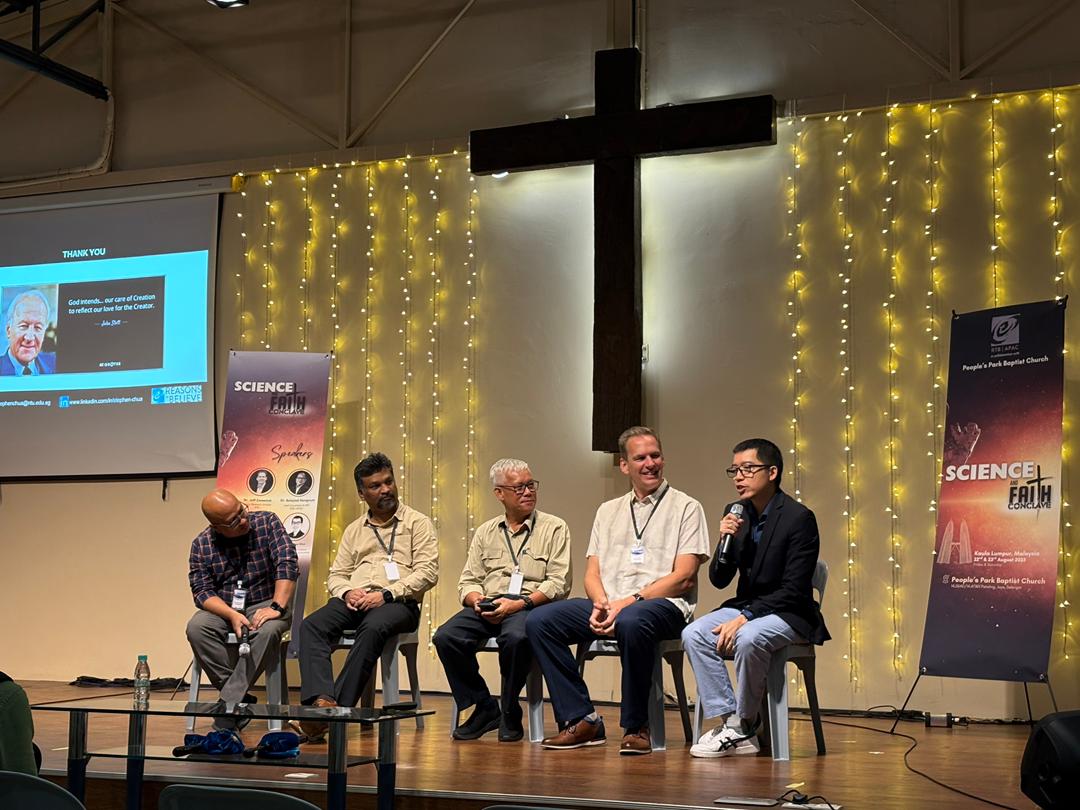
On 23 and 24 August 2025, curious minds and open hearts gathered at the People’s Park Baptist Church (PPBC) for the Science & Faith Conclave, a series of talks unpacking the relationship between science and faith.
The overwhelming argument: that sound reason and scientific research consistently affirm biblical truths.
“The conclave aims to explore the different possible relationship between Science and Faith in several fields of interest. As an organiser between Reasons to Believe (RTB) APAC and Malaysia, I am well pleased with the collaboration to host this conclave in Kuala Lumpur, bringing together many who are interested in Science and Faith issues, particularly for those engaged in Christian apologetics,” said Prof. Dr. Living Lee, Chairman Elder of PPBC.
In the opening keynote, Dr Jeff Zweerink set the stage by sharing from Genesis 1 on who God is, the creation of the universe, as well as humanity.
As a Christian and astrophysicist, Dr Zweerink shed light on the investigation of scientific and biblical data, concluding that science is a powerful tool to declare God’s glory and its discoveries is able to demonstrate the legitimacy and rationality of the Christian faith.
“Being a Christian drives me to pursue my scientific endeavours with integrity and in a way that honors God. Being a scientist equips me to think clearly and understand Christianity in a robust and God-honoring way,” he shared.
A historical perspective
According to Dr. Balajied Nongrum, Christian faith and Science are perceived to be in conflict. The RTB APAC Lead Consultant of Research and Apologetics explained that a common assumption is that one must accept Christianity by faith, whereas science is firmly based on evidence and reasons.
Over time, four models of interaction between faith and science emerged, namely conflict; compartmentalisation; complementarity; and integration.
In countering this perception, Dr Balajied shared that God has given us both disciplines, revealing Himself in nature (Psalm 19) and in Scripture (Romans 1:18-20). On that basis, he opined that there can never be a conflict between biblical and scientific facts since both scripture and nature are authored by the same God.
The challenge lies with man’s interpretations. He closed by sharing about how a famous astrophysicist and Nobel prize winner alluded to being failed by science in the quest to find contentment and peace, which remained largely unfulfilled after over 50 years.
Creation, evolution and geologic time
As a professor of geology specialising in paleontology and stratigraphy, Prof. Lee explained the theory of evolution, juxtaposed with the biblical account of creation that he upholds.
He commented that, “Science and faith are two different approaches to understanding origins. Evolution is derived from working within the self-defined boundaries of only looking for answers within the natural world through observation and deduction. On the other hand, creation is based on God’s revelation to us in the Bible.”
Prof Living went on to say that this is a supernatural act of a supreme being beyond mere human understanding and has to be accepted by faith in many parts of its timeless story.
“Hence the two can be held together with integrity. There is no necessity to harmonise both in terms of scientific accuracy, and we really don’t know the true picture of our origins unless we have a time machine to go back to observe all that unfolded,” he finished.
Medicine: God-given or man-made
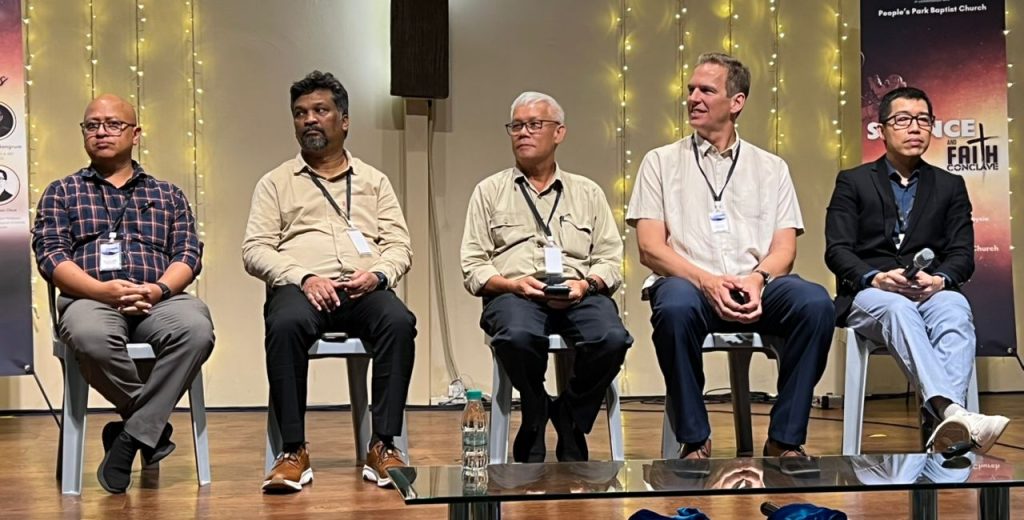
Another topic tackled with grace and humour was on medicine and its place in the Christian’s life. This discussion was led by Dr. Rajkumar Songa, a medical doctor and apologist. In opening, he quipped, “What is apparent may not be true and what may not be apparent may be true.”
He posed a simple question – “What colour are my shoes?” It was an apparent brown but scientifically, objects do not have inherent colours, they absorb and reflect different wavelengths of the electromagnetic spectrum. He pointed out that unless we are humble and know our limits to understand, reason and express, we will not be able to grasp it.
Dr. Songa also shared an interesting analogy of his medical studies with God’s creation and restoration story – subjects on physiology, biochemistry and anatomy illustrating God’s intricate creation, how learning about microbiology and pathology depicted what went wrong (the fall), and finally pharmacology and therapeutics representing the restoration.
Robust and interesting exchanges were further had as surrounding controversial medical issues such as abortion, euthanasia, and suicide.
Climate change and creation care
Finally, panelists and speakers spoke of climate change and creation care.
Dr Stephen Chua, Research Assistant Professor at the Earth Observatory of Singapore, made a profound statement, “Climate change is God’s design and creation care is God’s desire.” He explained that Earth’s climate has always changed throughout history – the ice ages, warm periods, and seasonal cycles.
These are part of God’s created order, designed to sustain life and promote biodiversity. Referencing Genesis 1:14-15 and Genesis 8:22 affirms God’s intent for cyclical rhythms in nature. In Genesis 2:15, he highlighted that God entrusted and called humanity to steward and not exploit the Earth. Thus creation care now becomes a spiritual discipline that glorifies God and blesses others.
There was a time of Q&A, and it was never short of intriguing questions raised by both old and young.
Grace, a member of PPBC, attended the conclave and came away more certain and equipped. “I’ve always been interested in Apologetics ever since I became a Christian. There are so many questions to uncover and at this conclave, the panel of speakers were able to articulate the answers to these questions so well, based on their expertise.”
Ultimately, the speakers emphasised that the desire to know more is a God-given design for humanity. As Christians, let us remain fascinated and constantly discovering God through His creation.


