
Review by Debbie Loh
The stories no one talks about can hold big lessons. Stories such as unanswered prayers for healing or for deliverance in the bodily sense. We hear the testimonies from a healing rally, but what do we know about those for whom healing didn’t happen? There isn’t much on record.
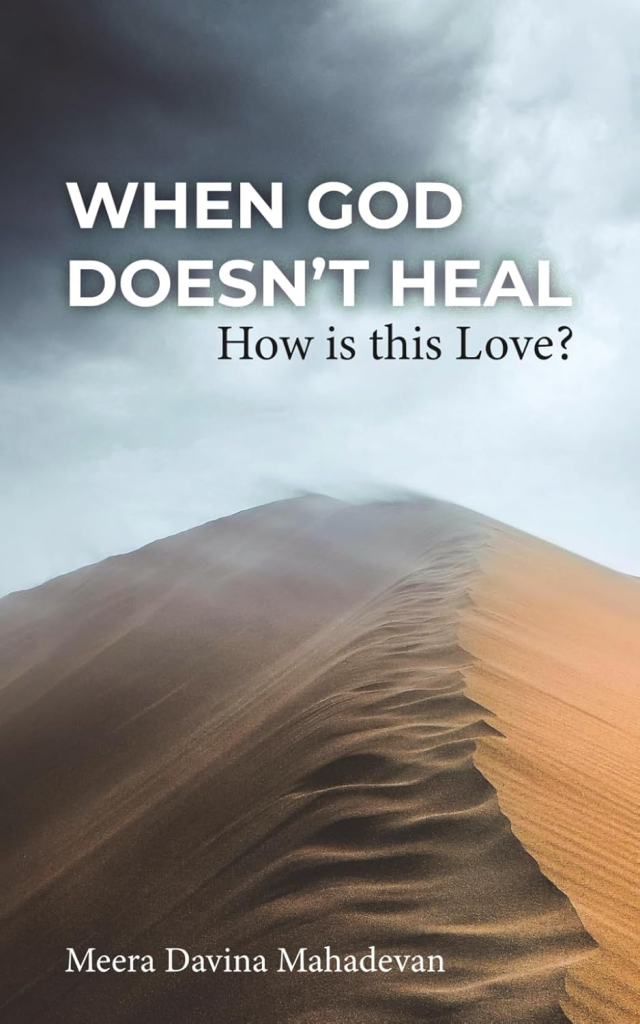
Meera Mahadevan’s book When God Doesn’t Heal: How is This Love? tells of the faith journey of one who pleads desperately for healing but does not receive it. Besides enduring pain, she also loses the dreams and future she hoped for. She writes as only one who has suffered can, confronting the question: why continue following Christ when He has allowed you suffering?
Her book is a series of journal entries that begin in 2014, the eighth year of being mostly bed-bound with intense pain from endometriosis and adenomyosis. A late diagnosis of her true condition leaves her in crippling agony for most of those years. Her life is put on hold, plans are shattered, and independence and identity lost. A first-generation Christian from a Hindu background, Meera highlights what was lacking from her discipleship journey:

“Never before had I heard about suffering as an integral part of life lived with Christ. Nor had I been taught about suffering as an intrinsic component in the life of a disciple. Let alone how to respond.
“If God is good, why did He redeem me only to ruin me now? If God is love, how is this love?”
To battle her doubt, Meera turned to journaling. Her writing–lyrical, meditative and full of imagery–peels back layers of her heart to uncover her motives for wanting healing. In the process, she re-learns who God is to her. She comes to understand that her desire for healing is a fixation on self, rather than the pursuit of God. She reflects on suffering as God’s will for her. She weighs it as the cost of discipleship for the purpose of becoming “joint-heirs with Christ” (Romans 8:17). She learns that complete submission is not the same as performing acts of obedience. She encounters a persistent God who relentlessly pursues her heart. And finally, she concedes that the only correct response is to love Him “with a love that seeks to give, not what it can gain”.
A disclosure here: Meera is a personal friend. I helped her with some editing of her book. I write this book review not to gain anything from it, but to explore what I feel is rarely discussed in Christian circles: God can heal, but what if He doesn’t?
Across Klang Valley churches, my impression is that much preaching on suffering is centred on overcoming pain and struggle. But Scripture also tells us that suffering is a core part of following Christ. Paul even exhorts us to desire to “share in Christ’s suffering that we might share in His glory”. However, it takes one who has suffered deeply to be able to speak authentically about what it means for discipleship. Perhaps that is why few sermons are dedicated to the topic.
Reading Meera’s book also brought to mind comparisons between the general responses to suffering among the different religious groups in our country. Muslims tend to view suffering as a test from God; Buddhists and Taoists accept it as universal and part of the impermanence of human nature; Hindus see it as a consequence of past actions.
Christianity is the only faith that says the God who created us, loved us, died for us and rose again, will be with us as we suffer, and will suffer along with us. But how do we minister that to the stricken? It doesn’t sound very cheerful. The more familiar Christian response is to seek escape from suffering by asking for healing or deliverance. It is more uplifting to claim victory in our prayers, to remind the sick that by His stripes, we are healed.
As Christians, we know that is true. But as Meera discovers, there is the matter of God’s promises, and there is the matter of God’s timing. Healing and deliverance may not happen this side of heaven. “The timing does not alter the Truth (that) He has promised me healing,” she notes.
The book is meant to be read one chapter at a time, like a devotional. It is not a light or easy read, given the topic and deeply personal nature. Readers who have had their own journey with pain and doubt will find much to resonate with, while others might be pricked to confront their current understanding and expectations of following Christ.
Whatever our respective journeys, one thing all who read the book will find is the persistence of a loving God in pursuing us. He is not after our performance, or our ministry or even our earthly healing, but our hearts.
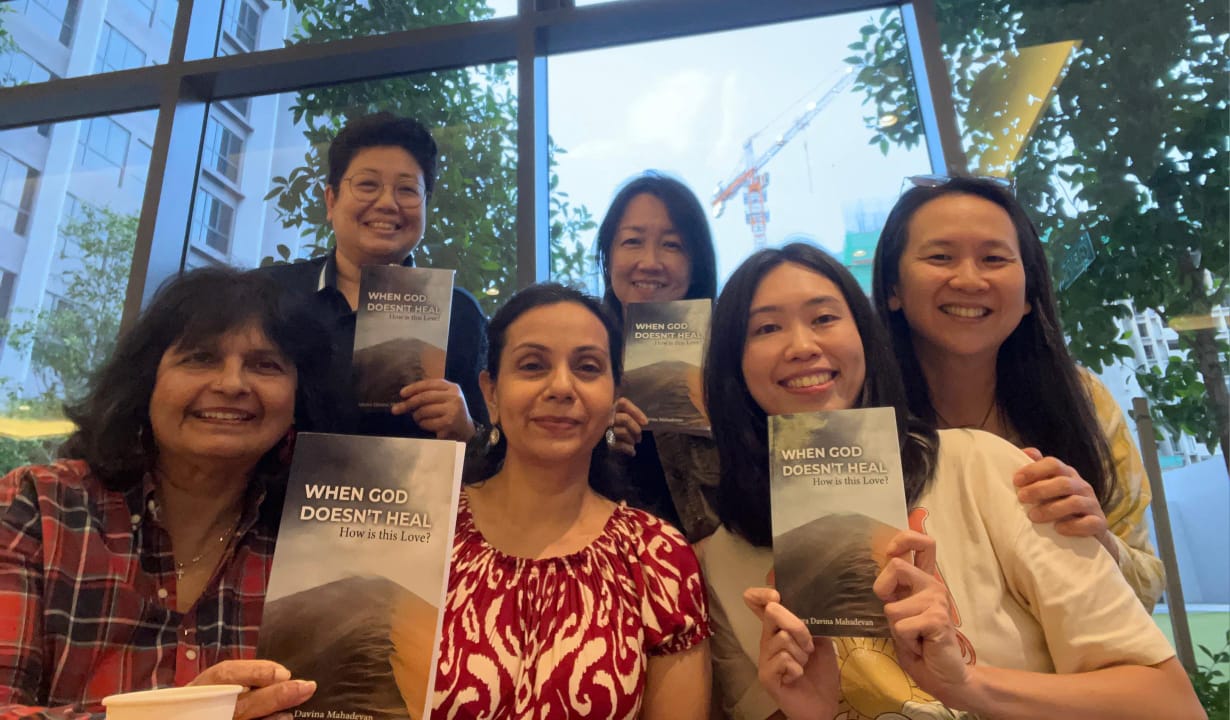
Cover Image: Meera (centre) at a meet-the-author session with a women’s prayer group. All photos provided by Meera Mahadevan.
When God Doesn’t Heal: How is This Love? was released in June 2025 and is available on Amazon here.


